Guide · US, UK & Ireland
Free-range parenting: a practical guide to childhood independence
Walking to school, going to the park with a friend, popping to the shop: these used to be ordinary parts of growing up. This guide covers what free-range parenting actually means, what the research says about independence, what age a child can walk to school alone in the US, the UK and Ireland, and how to build independence one small step at a time.
By the HUUUG team · Updated
What free-range parenting is (and isn't)
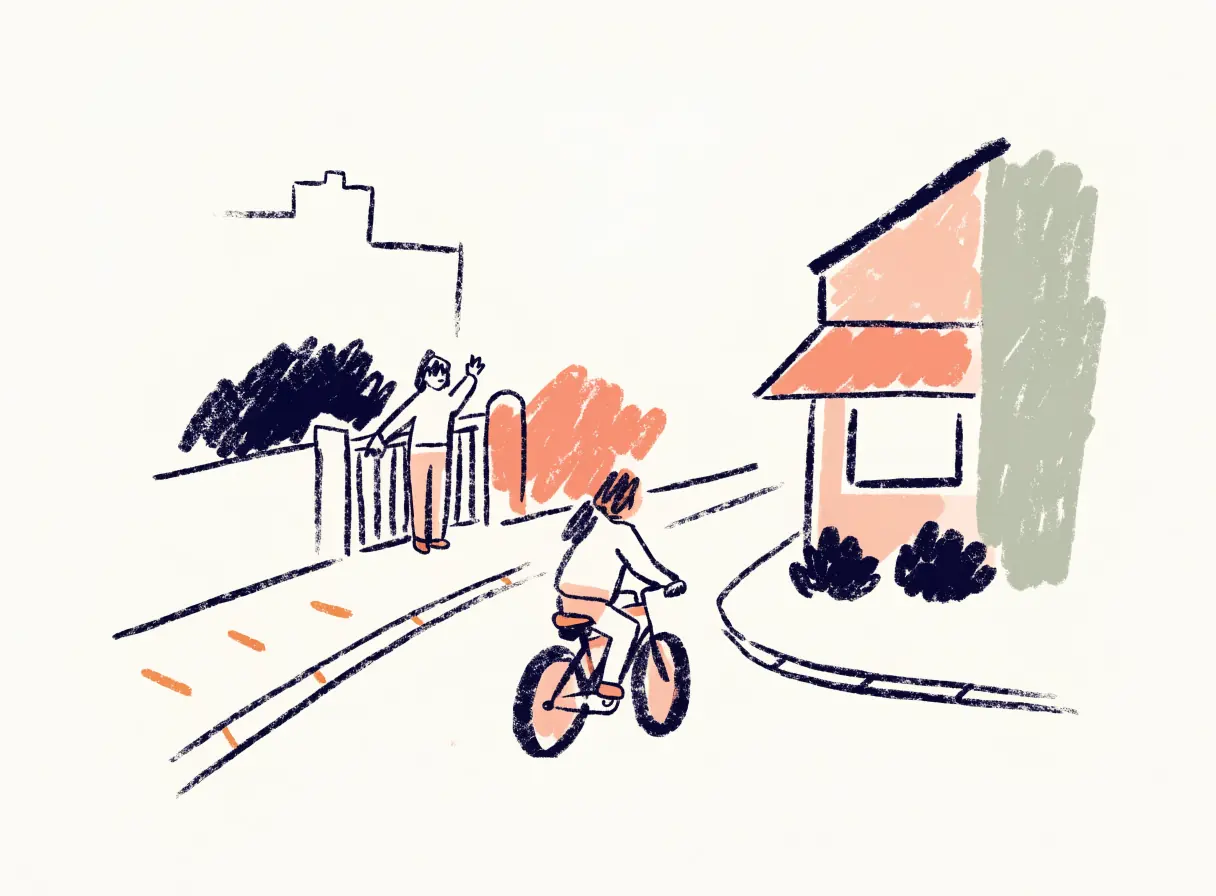
"Free-range" took off in 2008, when New York columnist Lenore Skenazy wrote about letting her 9-year-old ride the subway alone. The column made headlines and grew into a book and a movement (Wikipedia). Skenazy later co-founded Let Grow, a non-profit that works on policies and school programmes for childhood independence, with Jonathan Haidt, Peter Gray and Daniel Shuchman (Reason).
It isn't neglect, and it isn't "anything goes". It means giving children age-appropriate responsibility: trusting them with things they're ready for, after you've prepared them.
Why independence matters
In a 2023 commentary in The Journal of Pediatrics, psychologist Peter Gray and colleagues summarised decades of evidence and argued that the decline in children's independent activity is a major cause of the decline in their mental health. One striking number they cite: 47.7% of US children walked or biked to school in 1969, against 12.7% in 2009 (summary).
It's a summary of evidence, much of it correlational, and the authors call independence one cause rather than the only one. But the direction is consistent: kids who get to do things on their own tend to cope better. We've written more about the research in Independence as therapy.
What age can a child walk to school alone?
There's no single legal age in the US, the UK or Ireland. It's a parent's judgement, which is exactly why it feels so hard.
United Kingdom. There's no law setting a minimum age for walking to school alone. The NSPCC says it's up to parents to decide when their child is ready, and an NSPCC spokesperson has said many parents start around 9 to 11; a YouGov poll found 10 was the age most British parents felt was safe (LBC). Many schools have their own drop-off rules for younger pupils, so check yours.
Ireland. There's no legal age for walking to school alone. The closest official guidance is Tusla's on leaving children at home alone: there's no set legal age, but children under 14 are generally not seen as mature enough to be left alone or unsupervised for long (Tusla). That's about being home alone, not a walk to school, and parents' general duty of care still applies.
United States. There's no federal age. State laws differ, and a growing number of states have passed laws making clear that ordinary independence isn't neglect (next section).
What matters more than the number is readiness: does your child know your address and phone number, cross roads safely, know the route, and know what to do if something goes wrong? Our first walk to school alone checklist walks through it.
Reasonable childhood independence laws (US)
Utah passed the first "reasonable childhood independence" law in 2018. As of April 2026, Let Grow counts 13 states with such laws: Utah, Texas, Oklahoma, Colorado, Virginia, Connecticut, Illinois, Montana, Georgia, Florida, Missouri, Indiana and Kansas (Let Grow). The details differ, but the idea is the same: letting a child of suitable maturity walk to school, play outside or stay home briefly is not, on its own, neglect.
A federal bill, the Promoting Childhood Independence and Resilience Act, was introduced in Congress in May 2026; it hasn't become law. More: what these laws mean for your family and the federal bill explained.
Independent play
Independent play is unstructured time where children play without an adult directing it: in the garden, on the street, at the park with friends. It's where kids practise negotiating, taking small risks and solving their own problems.
It doesn't mean unsupervised from day one. Most families start close to home: the back garden, then the front, then the end of the road. Practical tips in Independent play is not unsupervised play, and the bigger picture in Why did independent play disappear?
How to build independence step by step
Think of it as a ladder, where each rung is a little further or a little longer:
- Inside a shop: "Go and find the cereal; I'll be at the till."
- Close to home: playing out front, or at a friend's on the same street.
- A known route with a friend: walking to school or the park in a pair.
- A known route alone: with an agreed time ("home by 4").
- A new place: the shop, the library, a bus ride.
Before each step: practise the route together, agree what happens if plans change, and make sure they know your number. Then let them do it, and resist the urge to follow. More in the 8–12 independence ladder and the first solo outing.
Where a tracker fits (and where it doesn't)
A tracker can't make a child ready. Readiness comes from practice and trust. What a tracker can do is make you ready to say yes, as long as it doesn't turn independence back into surveillance.
That's the thinking behind HUUUG. Your kid carries a small tag. You give the school a rhythm, like "there by 08:30 on weekdays", and the app stays silent unless that doesn't happen. There's no live dot to watch on the walk itself, just one sentence if you look. And your kid knows about it: telling them is the last step of setup. HUUUG isn't available yet.
Related: When a safety net lets you say yes.
Common questions
Is free-range parenting legal?
Generally, giving a child age-appropriate independence is legal, but child-welfare rules vary by country and state. In the US, 13 states have passed laws stating that reasonable independence isn't neglect. In the UK and Ireland there's no legal age for being out alone; it's a parent's judgement of their child's maturity.
What age can a child walk to school alone in the UK?
There's no legal minimum. The NSPCC leaves it to parents, and many start around 9 to 11.
What age can a child walk to school alone in Ireland?
There's no legal age. Tusla's only age benchmark is about leaving children at home alone (generally not under 14), which isn't the same as walking to school. Judge your child's readiness and your route.
How do I know my child is ready?
They know your address and phone number, cross roads safely, know the route, and know what to do if plans change. Practise the route together first. See our readiness checklist.
Getting started
- The first walk to school alone: a calm checklist for parents who aren't ready (but their kid is)Your child is ready to walk to school alone before you are. That's normal, and it's also fine. Here's how to prepare both of you for the moment the door closes behind them.
- The first solo outing: a readiness guide that isn't about dangerMost first-solo-outing guides start with worst-case scenarios. This one starts with your child. A gentle framework for knowing when the moment is right — and how a quiet location signal lets you say yes with confidence.
- The 8–12 independence ladder: small steps before the big onesA March 2025 survey found that 45% of children ages 8–12 have never walked a different store aisle than their parents, and 71% have never traveled anywhere without an adult. Those numbers are a starting point, not a verdict.
- When to scale back: a graduated tracking plan from age 4 to 12Tracking that made sense at four looks different at nine, and different again at twelve. Here is a quiet roadmap for letting oversight fade in step with the child who no longer needs it quite so much.
Play and the research
- What is "independent play" and why did it disappear?Exploring the developmental benefits of independent play and how modern fears have shifted parental practices away from it. HUUUG serves as the quiet solution for nervous parents.
- Independent play is not unsupervised play: the safety logistics nobody explainsExperts say a 5–7 year old can play alone in a fenced yard. What they don't explain is how to actually step back without losing your mind. A screen-free check-in is the practical bridge most guidance skips.
- 'Independence therapy': the research suggesting freedom is treatment for childhood anxietyNew peer-reviewed findings are formalizing something many parents have long sensed: giving children more independence doesn't just feel right — it measurably reduces anxiety. Letting go, it turns out, may be one of the most effective interventions available.
- Two-thirds of kids have never gone anywhere alone — what that statistic actually costs themA 2025 Harris Poll found that roughly two in three children ages 8–12 have never walked or biked somewhere without a parent. That number is striking, but what it represents — and what families can do about it — is more hopeful than it first sounds.
- When your pediatrician says 'let them out': translating doctor's advice into a planMore parents are leaving the doctor's office with advice to give their kids more independence — and no idea how to begin. Here is a calm, step-by-step way to turn that clinical nudge into something you can actually do this week.
Laws, guilt and letting go
- Reasonable childhood independence laws: what the states that passed them mean for your familyMore than a dozen states have now passed laws protecting parents who let their children do age-appropriate things alone. Here is what that legal shift signals — and why it matters more than most parents realise.
- Congress is trying to protect free-range parenting — here's what the bill actually changes for your familyA new federal bill would protect parents who let their children walk to a park or school alone. Here is what it actually says, what it leaves open, and why its introduction matters even if it never becomes law.
- The Georgia mom who was handcuffed: what happens when independent play meets the lawIn 2024, a Georgia mother was arrested after her 10-year-old walked alone to a nearby town. What followed reveals how safety tools can be turned against the very families they were meant to help.
- The good-parent tightrope: neither reckless nor controllingBehind most tracking decisions is a quieter question: am I being a good parent? Here is a framework for holding safety and freedom at the same time, without choosing between them.
- A safety net that lets you finally say yes to independenceFree-range parenting makes sense to most parents — until the moment they actually have to open the door and let their child walk away. A quiet fallback changes that calculation.